· ELM · 8 min read
TPR vs. TPU
TPR (thermoplastic rubber) and TPU (thermoplastic polyurethane) are both widely used elastomers—but they behave very differently in cost, abrasion resistance, optics, and injection molding.
TPR (thermoplastic rubber) and TPU (thermoplastic polyurethane) are mature, recyclable-friendly materials found across consumer goods, footwear, toys, and industrial parts. They can look similar at a glance—both are flexible thermoplastic elastomers—but their chemistry, property trade-offs, and how they run on an injection molding machine diverge sharply. This guide summarizes the practical differences engineers and buyers care about most.
What Is TPR?
TPR (thermoplastic rubber) behaves like vulcanized rubber in many respects (rebound, grip, cushioning) yet does not require vulcanization: it can be processed with standard thermoplastic routes such as injection molding, extrusion, and blow molding. It typically offers rubber-like abrasion and skid performance with a softer hand feel than many conventional rubbers, though ultimate tensile strength, fatigue endurance, and some mechanical extremes often trail those of sulfur-cured elastomers at similar formulation price points.
Industrial TPR formulations are commonly based on styrenic block copolymers such as SBS or SEBS, compounded with oils, fillers, and resins to tune hardness and surface.
What Is TPU?
TPU (thermoplastic polyurethane elastomer) is a segmented polyurethane elastomer commonly classified as polyester-type or polyether-type, depending on the soft segments. Typical selling points include a wide hardness window (roughly spanning very soft elastomer grades through harder “plastic” regimes), excellent abrasion and flex fatigue for many formulations, oil resistance, optical clarity options, and good elastic recovery—in short, a versatile engineering elastomer seen in footwear, tubing, wearable accessories, caster wheels, and more. Halogen-free flame-retardant TPU variants are also specified where flexible PVC substitutes are sought for regulatory or sustainability reasons.
At-a-glance Comparison: TPU vs. TPR
The chart below summarizes how the two families usually differ on base chemistry, tactility, abrasion, typical temperature envelopes, and common end uses. (Exact numbers depend on grade, fillers, plasticizer load, and part design.)
| Dimension | TPU (thermoplastic polyurethane) | TPR (styrenic TPE-family) |
|---|---|---|
| Base chemistry | Polyurethane elastomer segments | Often SBS/SEBS-family styrenic TPE compounded with oils/resins/fillers |
| Feel & optics | Tough-yet-soft, relatively slick surface; high clarity possible | Extremely soft “clay-like” feel possible; higher perceived friction vs. glossy TPU |
| Wear & mar | Excellent abrasion vs. typical TPR; higher tear resistance in many comparable grades | More prone to crumbs or surface damage under aggressive abrasive wear |
| Typical thermal window (indicative) | Often cited around −30 °C to 80 °C with strong low-temp flexibility when formulated for it | Often cited around −25 °C to 75 °C; can soften substantially at elevated service temperatures |
| Common applications | Phone cases, performance outsole overlays, resistance bands, casters | General footwear, toys, grips, yoga mats |
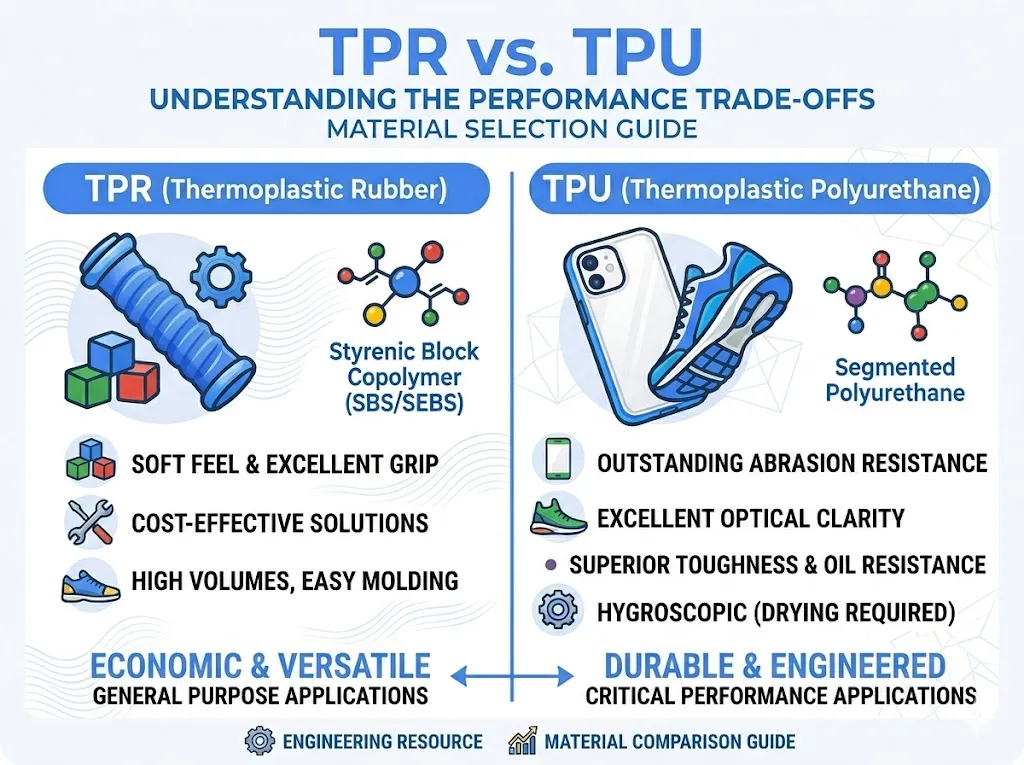
Typical Property & Application Differences
- TPU strength & durability — TPU is often specified where high tension, toughness, abrasion, oil exposure, transparency, and longevity dominate. Premium athletic footwear compounds are a flagship example—but pricing is usually higher than general-purpose styrenic TPR.
- TPR processing & economy — TPR compounds emphasize ease of molding and broad colorability from translucent to opaque; pellet shapes vary (sphere, ellipse, noodle) with characteristically glossy pellet surfaces due to formulation.
- Abrasion & optics — In head-to-head shoe-benchmark thinking, TPU frequently leads TPR on abrasion resistance and oil resistance while maintaining strong rebound—though compound-to-compound overlaps exist. Visually: transparent natural grades appear more routinely in commodity TPU; TPR is sold heavily in opaque black/natural palettes alongside clear options.
- Footwear construction reality — In many cost-driven casual soles and slippers, soft TPR compounds can economically stand alone. TPU is often laminated or co-injected as an abrasion shield or stiffening element alongside foams/other layers in performance builds—marketing language varies, but the procurement pattern reflects different price/performance bands, not interchangeable drop-in substitutes.
Across toys, stationery, grips, mats, and value footwear, TPR’s processing latitude and softness-for-cost frequently win placements; TPU remains the elastomer-of-choice when abrasion, chemical resistance, and structural toughness justify the uplift.
Injection Molding: Why TPU and TPR “Feel Different” on the Floor
Operationally, TPU behaves like a moisture- and shear-sensitive precision material, while TPR often flows like an easy forgiving TPE.
Before molding: drying (often the decisive split)
TPU is hygroscopic. Trapped moisture can hydrolyze chains at melt temperature—leading to silver streaking, bubbles, brittleness, or tacky surfaces. Use a desiccant dryer, typically heating pellets around 80–100 °C for 3–4 hours prior to molding. Undershooting dry time is a common root cause of “mystery” quality loss. Drying is only half of the uptime story—soft TPUs still fight the mold unless venting, draft angles, knockout area, and (when allowed) release chemistry are engineered together—see Mold temperature and release-agent notes below.
TPR (SBS/SEBS backbone) absorbs little water. Frequently you can mold without drying. Optional 60–70 °C for 1–2 hours in a heated hopper helps if pellets have surface condensation—or when chasing mirror gloss on picky cosmetics parts. Many commercial TPRs already bundle processing aids / internal lubricants, which partly explains why they “run easy” versus moisture-prone TPU.
Barrel temperatures, pressure, and screw management
| Parameter | TPU | TPR |
|---|---|---|
| Melt window (indicative) | Narrow: often ~170–220 °C; >~230 °C risks yellowing, brittleness, drool | Wide: ~140–210 °C with generous stability |
| Injection style | Higher pressure, moderate speed (viscous melt) | Lower pressure, moderate-to-fast (very fluid) |
| Back pressure | ~0.5–1.5 MPa; avoid excess shear heating | Can be near zero and still pack well |
| Screw speed | Keep low (e.g., 20–60 rpm) to limit shear burn | Can run higher to shorten plasticizing |
Mold temperature, release, and part ejection
TPU often prefers mold temperatures around 20–40 °C; softer grades may need aggressive cooling to freeze before ejection. Low-hardness (below 85 Shore A) TPU carries highly polar urethane segments that wet steel cavity surfaces unusually well, so adhesion forces spike—plants often observe sticky cavity-side behavior (“sticking to the wrong half”), scratching on ejection, or white-pull distortion even when draft looks adequate on paper. Mitigate mechanically first: draft steeper than about 1.5°, full-perimeter venting, large balanced ejector footprint (wide pins, blades, stripper rings).
Because mechanical fixes alone rarely carry high-cavitation glossy phone-case or textured shoe programs, production teams routinely add spray-on external mold release. Waterborne or fluorine-based sprays dominate when post-mold painting, plating, flocking, or adhesive bonding is on the roadmap. Classic silicone aerosols are a gamble on TPU: trace silicone films often cause paint adhesion failure, glue pop-off, or print flaking. If you truly need silicones, segregate molds, bake out per resin supplier guidance, or validate adhesion on witness plaques before scaling lots.
TPR tolerates ~30–50 °C mold temps (sometimes higher for gloss). Beyond faster freeze, compounded white oils and nonpolar rubbery blocks behave like built-in lubrication, so pellets slide and parts pop off cavities with comparatively little drama. Shops usually reserve incremental aerosol sprays only for deep bosses, long draws, intricate leather-grain negatives, or starving-draft legacy tools rather than spraying every cavity every shot.
Practical takeaway: release-agent economics are inverted
Industrial yield on soft elastomers is often gated by mold release—not by nominal melt temperature.
- Polar, soft TPU leans heavily on external or internal release chemistry because interfacial stick is chemically driven. Prefer silicone-free external films when downstream decoration or cementing matters, and escalate to compounder-guided masterbatch internal release when elongating cavity chill time clashes with the plant’s contracted cycle budget.
- Oil-plasticized TPR already carries implicit slip; spraying is opportunistic, not habitual. Economics favor fewer aerosol SKU line-items and tolerant handling of commodity silicone mold sprays when adhesion sensitivity is lower.
That contrast also shows up when comparing compound prices: seemingly “cheap” bare TPU can become expensive once amortized aerosol labor, VOC handling, adhesion rejects, or premium non-silicone chemistries pile on—whereas forgiving TPR sometimes wins total landed cost purely on tooling-friendly release despite higher oil volatility trade-offs designers must vet separately.
Engineering tips: internal release additives (beyond spray cans)
Teams chasing seconds per cycle without widening knit lines will often pivot from external sprays toward internal release agents (masterbatch concentrates) compounded at the material supplier—or post-blended under strict QA.
TPR/Styrenic TPE formulations frequently ship with fatty-acid soaps (e.g., zinc stearate), erucamide / oleamide-type slip, or micronized waxes folded in upstream. Those lubricants double as die drool inhibitors on extrusion runs and quietly boost automatic demolding—a major contributor to why TPR is described as “forgiving.”
TPU, however, is less tolerant of “extra slip.” Incorrect internal release doses can crash hardness, rob tear / modulus, or bleed to the surface as bloom (“frosting”) visible on clear parts. Vendors therefore specify narrow windows—sometimes amide or specialty ester concentrates between roughly 0.1 and 0.5 wt%, or tailored siloxanes engineered for urethane polarity—and still demand paddle-blend trials checking optics and bond tests after oven aging.
Treat internal release selection as tightly coupled with application: phone covers that must pass polyurethane topcoats tolerate different packages than translucent watch straps destined for ultrasonic welding. Coordinate early with compounders whenever secondary operations overlap.
Defect cheatsheet — opposite fixes
| Symptom | Try on TPU | Try on TPR |
|---|---|---|
| Short shots | Bump barrel heat slightly; increase injection pressure | Increase injection speed (TPR reacts strongly to shear/flow) |
| Bubbles / silver streak | Improve drying immediately; trim back-pressure | Micro-raise back pressure; improve venting |
| Flash / burrs | Lower heat; verify clamp tonnage | Reduce speed; shorten final pack/hold |
| Sticking / ejector distortion | Lengthen cooling; lower cavity temperature; external: migrate to aqueous / fluorinated (non‑silicone) mold releases that pass bonding or topcoat adhesion DOEs; internal: negotiate masterbatch doses (amide- or engineered-wax concentrates often near 0.1–0.5 wt%) with your compounder instead of blindly increasing silicone aerosols | Relax final pack pressure to curb over-packing distortion; synchronize ejector sequencing; reserve light conventional silicone mold-release sprays for deep ribs or embossed microtextures, validating cosmetics afterward |
Bottom line: match material to lifetime, chemicals, softness, optics, regulatory story, and your plant’s drying and process discipline—plus validate decor / adhesive cascades anytime mold release intersects cosmetics. Need an apples-to-apples benchmark? Mold paired plaques from candidate TPU vs. TPR grades at comparable hardness—not just identical Shore A readings—and test abrasion tabs, rebound, hysteresis at service temperature, mold-release aging panels for paint cement, and chemical exposure representative of field contact.